Frequently Asked Questions - led-light-sources


LED light Sources

The OptoLED can produce arbitrary pulse durations when driven by an external frequency generator..  So can the OptoFlash, but it ALSO has an internal timing circuit that can produce pulses anywhere between 50 microseconds and 100 milliseconds.

What the OptoLED has, and the Optoflash has not, are

1.  Two channels rather than one (of course).

Yes, it's pretty straightforward.  The only thing to bear in mind is that since both the diameter and radiation solid angle of the LED chip will be greater than a 100 micron fibre can accept, there will inevitably be a fair amount of light loss.  However, a lot of light will still get through, and since the illuminated area at the other end of the fibre will be correspondingly smaller, the illuminated area is likely to be just as bright as you could get for direct illumination.  Although you could in principle attach the fibre directly to the LED, in practice it's likely to b

In order to efficiently couple to a high Numerical Aperture (NA) objective lens, as required for epi-fluorescence measurements, it is crucial that the light is well collimated as it enters the back aperture of the lens.  In order to achieve this with the appropriate magnification the light must come from a small point, historically an arc lamp which is a reasonable approxiamtion of a point source.  Intense LEDs with emitters of approximately 1mm square work very well for this application.

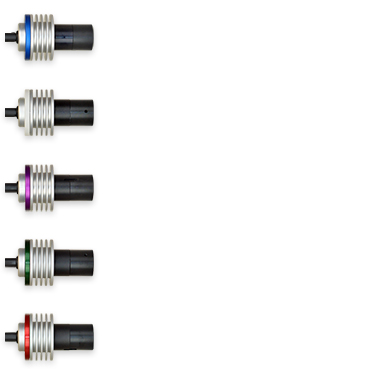
"White" LEDs typically comprise of a blue LED with a peak at approximately 445nm which is coated with a broadband phosphor centered in the green section of the spectrum.  Part of the blue emitted by the primary LED is absorbed and re-emitted at lower energy by the phosphor.  This combination of blue primary and green / red secondary emission appears white to the human eye.  Variants are sometimes described as cool white, neutral white or warm white reflecting respectively increased red output from the phosphor.  For fluoresecence applications both the primary a

The OptoLED can switch wavelengths in approximately 100 nanoseconds; effectively instantaneously in terms of biological measurements.  The Lite version has sub-millisecond performance which is sufficient for most applications. 

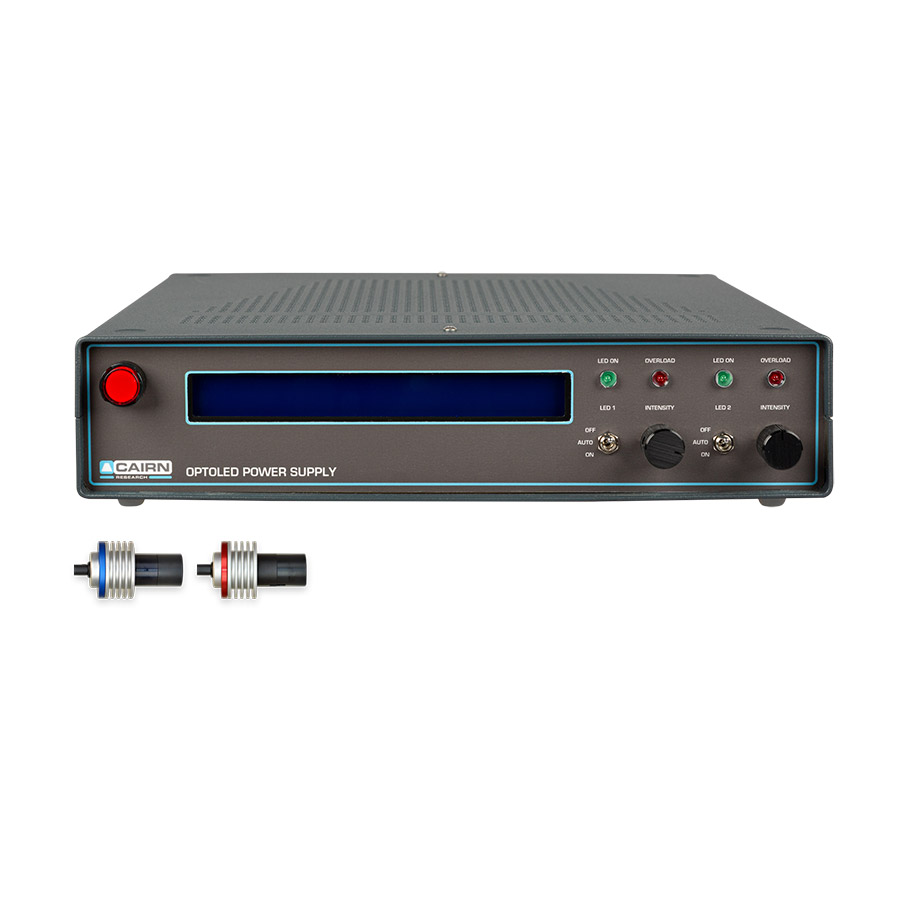
The OptoLED controls two LEDs independently, and it also give a very stable optical output thanks to its optical feedback option.  The LEDs can also be pulsed on and off extremely rapidly, with switching times on the order of 100 nanoseconds.  LED intensity is controllable either by varying a continuous current, or by varying the lengths of high-frequency current pulses, or some combination of the two.